I know exactly how that headline sounds. I understand the gut reaction it triggers—the image of a desperate mother, the thunder of engines, and children disappearing down the road. But before you judge me, look at the tears on my face. They weren’t tears of fear. They were tears of a deep, crushing relief I truly believed I would never feel again. To understand why I “begged” those bikers to keep my children, you have to understand what it’s like to be a woman who has been quietly drowning in plain sight for three years.
My name is Sarah. I’m the mother of three-year-old twins, Anna and Ethan. Their father disappeared when they were six months old, leaving behind nothing but a half-empty box of diapers and the hollow space where a partner should have been. From that point on, my life became a nonstop loop of survival. I worked mornings at a medical office and nights cleaning commercial buildings downtown. My mom was the only reason I could keep going—she watched the twins while I moved through my days like a shadow, running on caffeine and sheer determination to keep us afloat.
The breaking point started on a Tuesday that felt just like every other Tuesday. I had forty-seven dollars in my checking account and five days to go until payday. My grocery list wasn’t a list so much as a strategy: milk, bread, and the cheapest diapers I could find. As I pushed the twins through the store, I kept my phone’s calculator open like it was monitoring my pulse, watching the total climb item by item. I was exhausted—I’d worked until 3 a.m. and been up again with the kids by 6. Anna was screaming for cookies I couldn’t buy. Ethan kept throwing his stuffed rabbit onto the shiny floor like it was a game he couldn’t stop playing.
At the register, the total came up: fifty-two dollars. My stomach dropped. Five dollars. For most people, it’s nothing. For me, it was a wall I couldn’t climb. I felt humiliation rise up my neck as the line behind me started shifting and sighing. I began pulling items out, trying to decide what mattered most—whether we could live on less bread, whether I could stretch the diaper supply one more day.
Then a voice cut through my panic. Deep. Gravelly. The kind of voice that automatically takes up space.
“The bread stays. I’ve got the rest.”
I turned and froze.
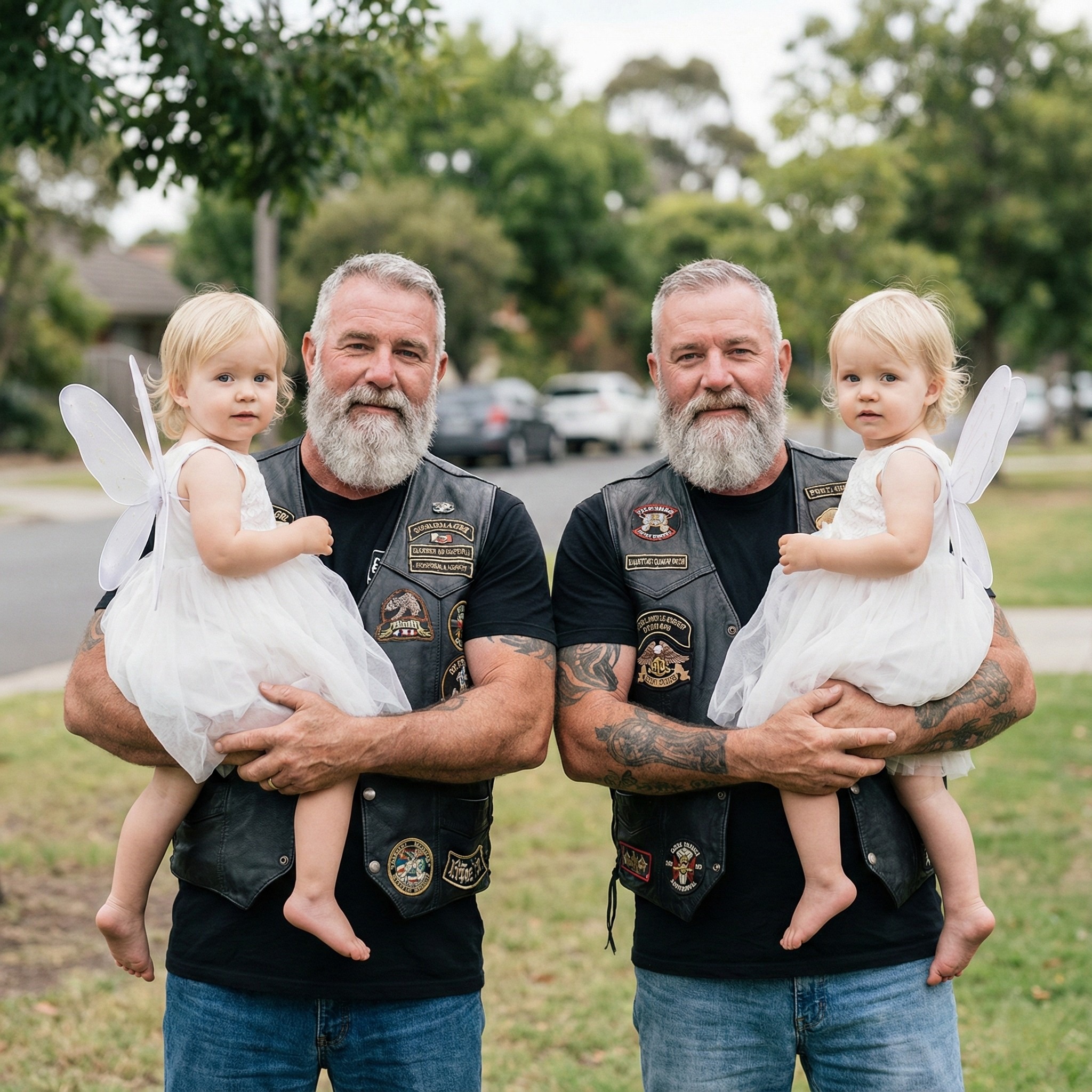
A man stood behind me who looked like every warning story I’d ever heard. He was huge—easily six-foot-four—with a beard that fell to his chest and arms covered in a dark map of tattoos. He wore a worn leather vest with patches I didn’t recognize. He handed the cashier a fifty-dollar bill and told her to keep the change to cover both totals.
I tried to protest. Pride flared, sharp and useless. But he just looked at me—steady, calm, unexpectedly kind.
“Already done,” he said.
He insisted on carrying my bags out to my dented 2004 Honda Civic. When we got there, he did something I never expected. He lowered himself until he was eye level with Anna and Ethan in their stroller.
“You two need to be good for your mama,” he said, his voice soft now, almost gentle. “She’s working real hard for you. You understand?”
He looked up at me, gave a small nod that felt like real respect, and said, “You’re doing a good job.”
Then he swung onto a massive Harley-Davidson and roared out of the parking lot.
I cried the whole drive home. I assumed that was the end of it—one random act of kindness from a stranger who looked intimidating but wasn’t. But over the next few months, I kept seeing him. A nod across the produce aisle. A wave from his bike near the park. It never felt like someone circling. It felt like someone quietly standing watch.
Then my life truly collapsed.
My mother had a massive stroke. In a single moment, my only childcare disappeared—replaced by hospital visits, endless worry, and the crushing reality of caring for a sick parent while raising two toddlers. I sat in my car in that same grocery store parking lot, struggling to breathe as the possibility of eviction and homelessness stopped feeling like a distant fear and started feeling inevitable.
That’s when there was a tap on my window.
It was him.
Marcus.
He didn’t interrupt. He didn’t offer shallow comfort. He listened while I spilled everything—the medical bills, the reduced work hours, the eviction notice creeping closer. When I finally ran out of words, he asked for my number and told me he might be able to help.
The next day, I found myself in a diner across from Marcus and one of his “brothers,” Jake. They explained that their motorcycle club was mostly made up of veterans, and they ran a volunteer childcare network for single parents in crisis.
“We know how we look,” Jake said as he slid a thick folder toward me. “But we’ve done this for years. Background checks. References. Families who’ll vouch for us.”
I was terrified. But I was also out of options.
We started with supervised playdates. I watched two men who looked like they belonged in people’s nightmares sit on the floor playing tea party with Anna and building block towers with Ethan. Their patience wasn’t performative. It was real—the kind I hadn’t been able to offer in months because I was running on fumes.
Jake—who worked from home in IT—and Marcus—retired military—began splitting childcare for my twins at no cost while I worked.
They didn’t just watch my kids. They filled the empty spaces in our lives. They taught Ethan to tie his shoes. They helped Anna with her alphabet. When I got the flu, they showed up with soup and ginger ale. When my car wouldn’t start, three bikes arrived to jump it like it was the most normal thing in the world. They became the “village” everyone talks about, but almost no one actually provides.
The day I “begged” them not to bring the kids back was after the club’s annual family picnic.
They picked up the twins at 9 a.m., and for the first time in three years, I sat in a silent apartment. I didn’t even know how to act in the quiet. I cleaned. I fell asleep. For the first time in ages, I felt the tension in my shoulders begin to loosen.
At 8 p.m., Marcus called and said the twins had fallen asleep on the clubhouse couch after a day of ice cream and movies. And suddenly I realized I wasn’t ready to step back into the constant vigilance of motherhood that night—not immediately, not yet.
I went to the clubhouse to check on them, and what I saw is burned into my memory: my children asleep under blankets on a leather sofa, surrounded by a dozen “terrifying” bikers playing cards in near silence so they wouldn’t wake them. One man was knitting a scarf.
“Can they stay?” I asked, my voice breaking. “Just for tonight. I just need to sleep without listening for a cry.”
Marcus smiled and told me Jake’s wife had already brought extra pajamas. Then he sent me home.
I slept for twelve hours straight. I woke up to a photo of Anna and Ethan eating pancakes.
People still judge us when we’re together. They see leather and tattoos and they pull their children closer. They don’t see the men who kept my family from falling apart. They don’t see “Mr. Bear,” who can make my daughter laugh on her worst day, or “Uncle Jake,” who is showing my son what a real man looks like—someone strong enough to be gentle.
Marcus and Jake didn’t kidnap my twins for a weekend. They took our fear and replaced it with hope. They are living proof that you can’t measure a person’s heart by how they look—only by how they show up when someone is desperate and the rest of the world is looking away.
They are our family now.
And they are the best thing that ever happened to us.
About the Author