I saved a dirty, miserable animal from the riverbank, thinking it was just an ordinary abandoned puppy. I wrapped it in my jacket, took it home, and gently washed away the layers of mud and filth. But as the water ran clear and the creature’s true features emerged, I realized with mounting horror that what I’d rescued wasn’t a dog at all. Those amber eyes, those powerful claws, that thick gray fur—I’d brought a predator into my home, and now I had to figure out what to do before it was too late.
I work at a chemical manufacturing plant on the outskirts of Bellingham, Washington, one of those sprawling industrial complexes that seems to exist in its own world, separate from the town proper. The factory stands almost at the edge of the Cascade foothills, a strange boundary between human civilization and the wild. From the main gate to the Nooksack River, it’s only about a ten-minute walk through a narrow strip of woods that somehow survived when they cleared the land for construction. Most of my coworkers drive straight home after their shifts, eager to leave the smell of chemicals and the noise of machinery behind. But I’ve always preferred walking when the weather allows, taking the dirt path that runs along the river before connecting to the main road that leads back into town.
That October evening was overcast and cold, the kind of Pacific Northwest autumn day where the mist seems to seep up from the ground itself rather than falling from the sky. The air smelled of wet earth and decaying leaves, and a light fog hung over the water like a living thing, moving and shifting with currents I couldn’t see. I’d just finished a ten-hour shift—I’m a quality control technician, which means I spend my days testing chemical compositions and making sure nothing goes catastrophically wrong—and my body ached with the particular exhaustion that comes from standing on concrete floors under fluorescent lights for too long.
I was about to turn toward the bridge that would take me across the river and onto the paved road when I noticed something strange near the riverbank, about twenty feet from where I stood. At first, in the dim light and swirling mist, it looked like nothing more than a lump of debris—trash, maybe, or a pile of dead grass and mud that the current had deposited on the shore. The river had been running high after several days of rain, and its banks were littered with branches, plastic bottles, and other detritus.
But then the lump moved. Just slightly, just enough that I stopped walking and stared, trying to make sense of what I was seeing through the fog.
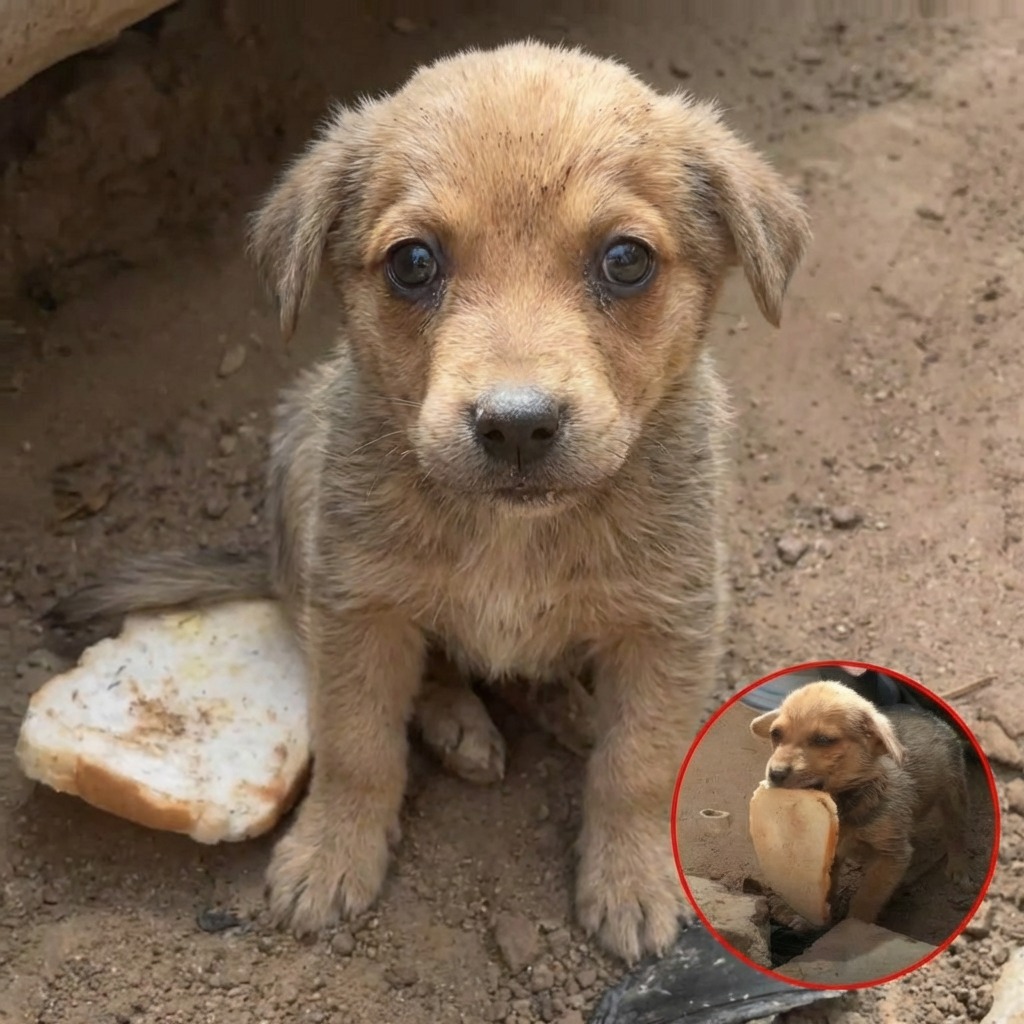
I moved closer, my work boots squelching in the mud, and that’s when I realized with a jolt of recognition and horror that the lump was breathing. It was a living creature, small and completely covered in filth, barely distinguishable from the mud and grass that surrounded it. As I knelt down beside it, I could see matted fur, or at least what I thought was fur beneath the layers of grime. Its sides were rising and falling with shallow, labored breaths.
“Oh God,” I whispered, my voice barely audible over the sound of the river. “Poor puppy.”
That’s what I thought it was—an abandoned puppy, maybe one of the unwanted litters that people too cowardly to take to a shelter sometimes dumped in rural areas. Someone must have thrown it in the river, I thought, my anger rising at the casual cruelty of it. Maybe they’d weighted down a bag or a box, thinking the current would carry it away or that drowning would be quick. But somehow this little creature had survived, had made it to shore, and was now lying here barely clinging to life.
I reached out carefully, not wanting to startle it or hurt it if it was injured. My hand touched its side, and I felt warmth despite the cold mud coating its body. It was a tiny thing, no bigger than a loaf of bread, and when I made contact, it made a sound—a pitiful whimper that went straight to my heart. It was a sound of pure misery, of exhaustion and fear and hopelessness.
“It’s okay,” I said softly, though I had no idea if anything was okay. “You’re safe now. I’ve got you.”
I gently picked it up, cradling it in my hands. It was surprisingly heavy for its size, solid and compact rather than the light bundle of fluff I’d expected. The creature’s body was trembling—whether from fear, from cold, or from shock, I couldn’t tell. Probably all three. Its eyes were barely open, just slits of darkness in a face so covered with mud I could barely make out any features. But it pressed itself against my hands, seeking warmth, seeking safety, and something in that gesture of trust broke my heart.
I quickly took off my jacket, a thick canvas work jacket that still smelled of chemicals and machine oil, and wrapped the creature in it, creating a makeshift nest against my chest. Then I started walking home as fast as I could without jostling my precious cargo. The temperature was dropping as evening turned to night, and I knew hypothermia could kill something this small and wet within hours. Maybe it was already too late. Maybe I was just carrying a dying animal home to watch it suffer. But I had to try.
All the way home—a twenty-minute walk that felt like an hour—the filthy creature shivered against my chest, its trembling vibrating through the fabric of my jacket and shirt. I could feel its tiny heart beating rapidly, a frantic drumbeat of life fighting to continue. I talked to it the whole way, nonsense really, just a steady stream of reassurance. “You’re going to be okay. We’re almost there. Just hold on. You’re safe now.” Whether the words were for the creature or for myself, I wasn’t sure.
I live alone in a small rental house on the east side of town, nothing fancy but comfortable enough for someone whose life revolves around work and solitude. I’d lived there for three years since moving to Bellingham for the job, and in that time I’d barely decorated, barely made it feel like home. But tonight, as I fumbled with my keys and finally got the door open, it felt like a sanctuary, a safe harbor from the cold and the cruelty of the world outside.
The first thing I did was turn up the heat. Then I went straight to the bathroom and started filling the tub with warm water—not hot, because I remembered from some long-ago first aid training that you shouldn’t warm up a hypothermic person or animal too quickly. While the water ran, I grabbed some old towels from the linen closet and laid them out on the bathroom floor.
The creature was still wrapped in my jacket, still trembling, but when I carefully unwrapped it and set it down on the towel, it opened its eyes a bit wider and looked at me. I couldn’t read the expression in those mud-caked eyes, but there was an awareness there, an intelligence that made me pause.
Okay, little one,” I said softly. “This is going to be uncomfortable, but we need to get you clean and warm. Bear with me.”
I gently lowered the creature into the warm water, supporting its body with both hands. The moment the water touched its fur, the dirt began to slide off in thick, dark streams that turned the bathwater murky within seconds. The creature didn’t struggle or try to escape. It just stood there in my hands, docile and exhausted, letting me do what I needed to do.
That’s when I first started to feel that something was wrong, that something didn’t quite add up. I told myself it was just my imagination, just the stress of the day and the adrenaline of the rescue. But as I worked the water through its fur, as I gently scrubbed away layer after layer of mud and river silt and God knows what else, a strange unease began to grow in my chest.
At first, I was simply glad to finally see its real color emerging from beneath the filth. The gray-brown layer of mud gave way to thick, surprisingly beautiful fur—not the soft puppy fuzz I’d expected, but a dense, coarse coat in shades of gray and silver. The more I washed, the more I could see, and the stronger that strange feeling grew.
The fur was wrong. Too thick, too coarse, nothing like any dog breed I’d ever encountered. And it wasn’t just the texture—it was the pattern, the way it grew, the subtle gradations of color that seemed more wild than domestic.
The ears were pointed and stood erect on the creature’s head, but they were slightly too long, too large in proportion to the skull. And the skull itself, now that I could see its shape, was broader than a puppy’s, more robust.
But it was the paws that made my hands freeze in the water. They were large—far too large for the body—and tipped with claws that weren’t the dull, rounded nails of a domestic dog but sharp, curved weapons designed for digging and gripping and tearing. Each toe was powerfully muscled, each claw a glossy black hook that caught the bathroom light.
My heart began to beat faster, a sick feeling spreading through my stomach. I looked down at the creature standing in my bathtub, at the water dripping from its now-clean fur, and watched as it lifted its gaze to meet mine.
Amber eyes. Not the brown or blue of a domestic dog, but a bright, piercing amber that seemed to glow faintly in the fluorescent light of my bathroom. Eyes that were ancient and wild, that belonged to something that had never been tamed, never been bred for companionship or obedience.
And then it made a sound—not the whimper of a puppy, not even a bark, but a low, rumbling growl that seemed to vibrate through the water and into my bones. It wasn’t aggressive, not exactly. More like a warning. More like the sound of something saying, “I see you. I know what you are. And I am not what you think I am.”
My hands, which had been gently washing, went completely still. The realization crashed over me like a wave of ice water.
This was no puppy. This was no dog at all.
About the Author