After a long shift and a moment of quiet kindness at the grocery store, a tired mother finds her ordinary life interrupted by an unexpected knock at the door. What follows is a quiet unraveling of grief, grace, and one man’s final request that changes everything.

I was bone-tired—so exhausted that one more wrong beep in the bread aisle might have pushed me to tears.
The fluorescent lights buzzed overhead, their hum a little too loud, casting everything in a dull yellow haze that made the world feel heavier than it already was. My feet throbbed after a 12-hour shift, the kind of deep ache no hot bath or cup of tea could fix. It was the sort of bone-deep exhaustion that reminded me—loudly—that being 43 wasn’t nearly as young as it once felt.
The fluorescent lights buzzed overhead.
All I wanted was to get in and out of the grocery store.
Bread, milk, cheese, maybe something frozen for dinner—just the basics for a working mom who hadn’t slept properly in years. With my daughters, fifteen-year-old Ara and seventeen-year-old Celia, both sniffling with colds while juggling homework, and the house teetering in post-divorce chaos, burnout hovered so close that even pushing the cart felt overwhelming.
It was the usual survival kit for a working mom…
I paused near the entrance, brushing a loose curl behind my ear. That’s when I noticed Rick, the store manager, standing by the registers. I offered a tired half-smile and stepped toward him.
“How’s Glenda doing?” I asked, surprised by how raspy my voice sounded.
He looked up, his face brightening as though I were the first good thing he’d seen all day.
“She’s doing a lot better, Ariel,” he said. “She still talks about how gentle you were with her after surgery. She thinks you’ve got magic hands.”
My voice came out raspier than I expected.
“She just liked the pudding I brought her,” I said with a laugh.
“How are the girls?”
“Still fighting over whose turn it is to feed the cat. Celia’s got a science project on fungi growing somewhere in her closet, and Ara’s upset her team didn’t make the finals. So… we’re hanging in there.”
He smiled and gave me a playful salute before returning to his work. I pushed my cart down the first aisle and finally allowed myself a breath.
“So… we’re hanging in there.”
The store was packed—the usual Thursday evening rush that made everyone forget their manners. Carts squeaked. A toddler screamed somewhere near the cereal aisle. An announcement about rotisserie chickens crackled over the speakers.And in the express checkout lane ahead of me stood an older man.
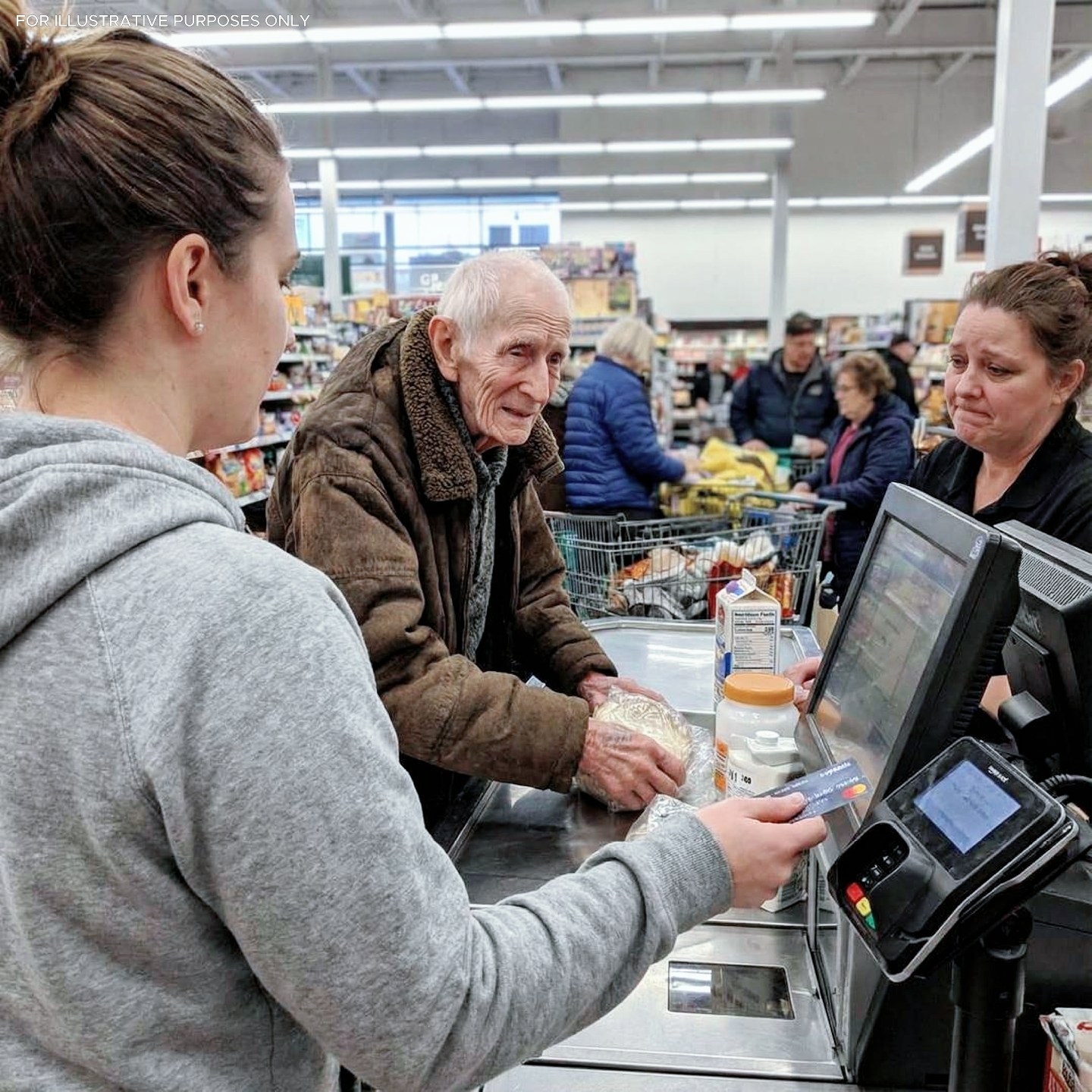
He was small, slightly hunched, wearing a faded jacket that had seen far better decades. His hands trembled as he placed a loaf of bread, a jar of peanut butter, and a small carton of milk on the belt—items so simple and essential they almost hurt to look at.
Someone’s toddler screamed in the cereal aisle.
These were the groceries of someone who counted every cent.
Then came the beep.
Declined.
The man swallowed and slid the card again, quiet desperation tightening his features.
The machine repeated the same sharp, unforgiving sound.
Declined.
Again, the red message blinked at all of us: Declined.
The cashier hesitated, eyes shifting between him and the growing line. Her hand hovered uncertainly over the conveyor belt, unsure whether to continue.
A woman behind me clicked her tongue. Someone else sighed dramatically.
The cashier glanced at him…
A man a few feet back muttered, “Oh, for goodness sake… some of us actually have places to be before we’re that age.”
The older man’s cheeks flushed red. His gaze dropped to the counter, shoulders curling inward like he wished he could disappear.
“I… I can put things back,” he said softly—his voice barely louder than the buzzing lights. “That might help, right?”
“I can put things back,” he said softly.
My chest tightened. I hated how small he sounded. I hated how no one paused. And most of all, I hated how familiar that humiliation felt—the instinct to shrink when life unravels in front of stranger.
About the Author