The Sheriff Suspected the Veteran of Causing Problems—Until a Midnight Land Deal Exposed the Truth Behind the Quiet Tension Unfolding Across the Backroads of Rural Montana and Changed Everything He Thought He Knew About the Man Living Next Door There.
He swore he wouldn’t come back to Montana, not because he hated it, but because he knew exactly what those wide valleys and blunt-edged mountains would do to him if he stood still long enough to let them work, and standing still had never been his strong suit anyway, not after the war rewired the way his pulse answered to silence.
The last time Callan Rourke had driven west through those long, wind-peeled stretches of highway, he’d worn a uniform that made strangers nod at him in airports and had believed, with a stubborn kind of faith, that belonging was something you could earn if you bled in the right places. Now he came back in a secondhand pickup that rattled above sixty, his left knee braced under denim, a duffel bag tossed behind the seat, and a Belgian Malinois named Vex riding shotgun, eyes scanning every overpass and roadside mailbox as if the entire state might detonate without warning.
The deed to the property sat folded in his jacket pocket, creased so many times it felt like cloth instead of paper, inherited after his mother’s quiet passing and as unwanted as it was inescapable, because land, especially in rural Montana, isn’t just acreage—it’s memory with boundaries, it’s argument, it’s the kind of inheritance that drags your name through other people’s opinions whether you like it or not.
The house that once stood on that land was gone, burned to the foundation six years earlier according to the one neighbor who still bothered to answer unknown numbers, the official story wrapped in insurance disputes and shrugs, the unofficial story stitched together by barroom whispers about faulty wiring and an electrical inspection that never happened, and by the time Callan parked at the weed-choked turnout and cut the engine, all that remained was a sagging shed that leaned like it was tired of pretending, a scatter of blackened foundation stones swallowed by grass, and an old yellow school bus rusting into the soil like some prehistoric animal that had wandered too far from water and simply given up.
He climbed inside the bus because it was the only roof that didn’t require permission, and the metal floor groaned under his weight while Vex circled twice before pressing his flank against Callan’s thigh, firm, deliberate pressure that said you’re here, you’re breathing, count with me, and the rain that evening tapped against the bus’s skin in arrhythmic bursts that sounded too much like distant gunfire for comfort.
The air inside smelled of iron and damp vinyl, and somewhere near the back a panel sagged where moisture had worked its way in over the years, and Callan told himself this was temporary, just a week or two until he sold the land, signed whatever papers needed signing, and left Montana to its silence and its sideways glances, because staying would mean admitting that the life he’d built elsewhere had collapsed under the weight of its own expectations.
That first night, somewhere between one shallow breath and the next, his chest tightened the way it sometimes did when sleep came too quickly, and the panic arrived not as a dramatic wave but as a cold, clinical takeover—ringing ears, a narrowing tunnel of vision, the kind of pressure that makes a man wonder whether his own body has decided it’s had enough of carrying him. He slid down the side of a cracked bus seat and braced his palms against the floor, focusing on Vex’s steady inhale and exhale, counting them, because counting something alive is easier than counting your own spiraling thoughts, and Vex didn’t bark or whine or attempt theatrics; he simply stayed close, anchoring Callan with the weight of his presence until the worst of it passed.
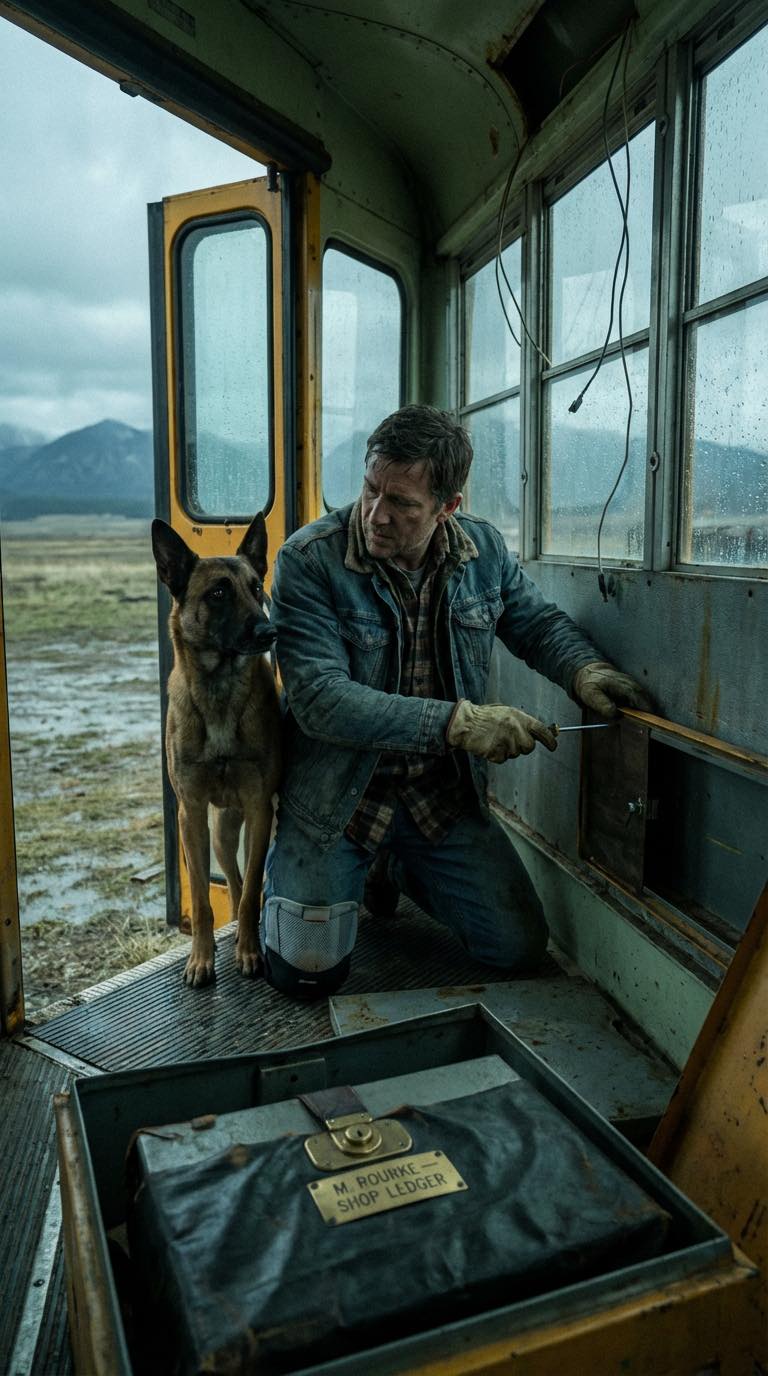
Morning stripped the bus of its nighttime ambiguity and revealed every flaw in harsh daylight: torn wiring hanging like exposed nerves, insulation that had rotted into a gray pulp, a floorboard near the rear axle that dipped when stepped on, as if something beneath it had surrendered long ago, and Callan stood there with a screwdriver in one hand, staring at that soft spot while Vex returned to it again and again, pawing, sniffing, then glancing up as if awaiting an order.
“You don’t quit, do you,” Callan muttered, kneeling with a grunt and wedging the screwdriver beneath the warped panel until the old screws squealed and gave way.
The compartment beneath was too clean to be accidental, sealed with care, lined in plastic that had held back time better than the rest of the bus, and inside sat a metal lockbox wrapped in oilcloth, the brass tag affixed to its handle dulled but still legible: M. ROURKE—SHOP LEDGER.
The name struck him harder than the panic attack had. Malcolm Rourke. His grandfather. The man who had built barns for half the county and never once asked for a plaque or a thank-you, who had taught Callan to plane wood against the grain without splintering it, who had died without ever understanding the war Callan chose to fight or the distance that followed.
Callan’s hands trembled as he lifted the box free and pried open the latch. Inside lay a leather-bound journal swollen at the edges, a small ring of keys tagged with masking tape, and a folded letter dated nearly twenty years ago.
The first line didn’t ease him into anything; it hit like a hammer blow: If you’re reading this, it means you came back carrying something heavier than your pack.
He let out a sound that might have been a laugh if it weren’t so close to breaking.
The journal pages were filled with practical sketches—cabinet joints drawn with an engineer’s patience, measurements for insulation, vent diagrams for wood stoves, notes in the margins about mistakes that cost more than they were worth. It wasn’t sentimental. It was instructional. The letter tucked at the back was shorter, the handwriting steady and blunt.
You’ll want to run, it read. Running feels like control. But control is just fear wearing boots. Find something broken. Fix it. Let the work hold you up when you can’t hold yourself.
Outside, tires crunched on wet gravel.
Callan closed the journal slowly and looked through the smeared bus window to see a county patrol SUV idling where no one had business idling. A man stepped out, hat low, posture already shaped like a verdict. Vex’s hackles lifted in a silent ripple, not explosive, just alert, and Callan felt the familiar tightening in his gut that preceded confrontation.
Sheriff Colter Wade didn’t knock right away; he stood in the rain as if the bus itself offended him, one hand resting near his belt, gaze traveling from rusted bumper to cracked windshield like he was cataloging evidence for a future report.
When he finally rapped his knuckles against the metal door, it was firm and measured. “You planning on opening up, or we doing this through sheet metal?”
Callan opened the door with both hands visible, shoulders squared but relaxed. “Can I help you?”
“Name,” Wade said, not because he didn’t know it but because hierarchy sometimes demands repetition.
“Callan Rourke.”..
Read More…
About the Author