After Spotting a Widow and Her Children Stranded in a Blizzard, a Member of the Hells Angels Motorcycle Club Leaned Close and Whispered, “Come With Me”—Setting in Motion an Unexpected Act of Protection and Kindness No One Saw Coming Night
The wind didn’t just howl that night — it judged.
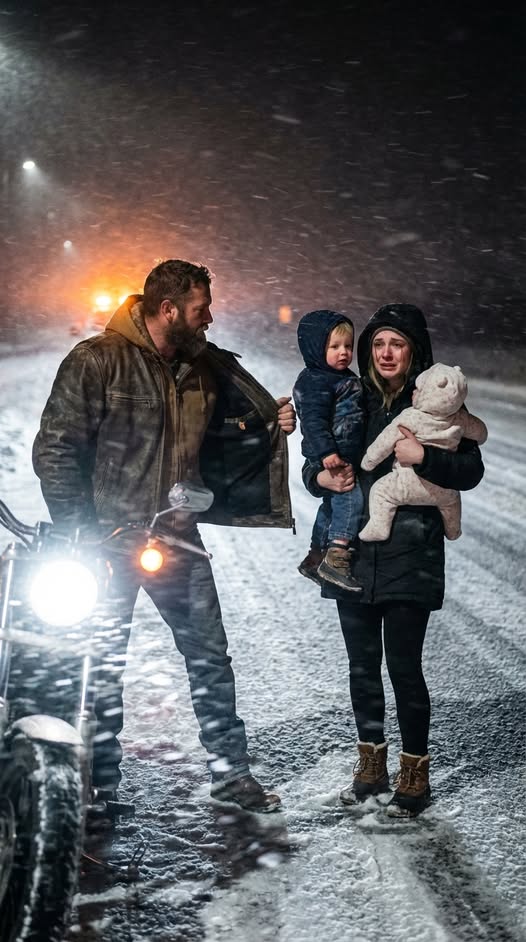
It scraped across the open highway like something alive and furious, flinging snow in sideways sheets so thick they erased distance, erased direction, erased the illusion that anyone was in control of anything. The world had collapsed into white and sound, and Lena Harrow stood in the middle of it, clutching her children so tightly she could feel their ribs through their coats, wondering whether this was how endings happened — not with drama, but with quiet freezing.
Her boots were soaked through. She had stopped feeling her toes half an hour ago. The baby inside her coat, tucked against her chest beneath a borrowed scarf, was too still. That terrified her more than the storm.
In front of her, six-year-old Ivy tried to stand straight even though the wind pushed her sideways. Ivy had inherited her father’s stubbornness and her mother’s dark eyes, and tonight those eyes looked older than any child’s should. Four-year-old Nora clung to Lena’s thigh, her tiny fingers knotted in the fabric as if letting go meant disappearing.
“Mom,” Ivy said, her voice almost lost in the gale, “are we almost there?”
There was no “there.” There hadn’t been for weeks.
The bus station had closed early because of the weather. The battery on Lena’s phone had died somewhere between desperate calls and unanswered voicemail greetings. The landlord had changed the locks that morning. Her sister in Ohio had promised to send money, but promises didn’t warm children. So Lena had walked. She had convinced herself that if she could just reach the highway, someone would stop.
No one had.
Until the engines came.
At first it sounded like distant thunder, but steadier, mechanical, purposeful. A low vibration rolled across the frozen asphalt beneath her boots. Headlights punched through the storm — one, then another, then four beams slicing the white like knives.
Lena’s stomach dropped. Every headline she had ever skimmed in passing rushed back at once — violence, gangs, men who lived outside the rules, who answered to no one. She shifted her body, instinctively placing herself between her daughters and the approaching figures.
One of the riders removed his helmet.
He wasn’t what she expected.
Yes, he was large, broad-shouldered beneath a weathered black jacket patched with an insignia she didn’t recognize. His beard was threaded with gray. His hair fell to his collar, damp with melting snow. His eyes, though — his eyes were not reckless.
They were tired.
He took one slow step forward, hands visible at his sides.
“You can’t stay out here,” he said. His voice was rough, but not cruel. “This storm’ll bury you before morning.”
Lena swallowed. Her lips were so numb she could barely form words. “We’re fine,” she lied.
The man’s gaze dropped to the children. Bare hands. Thin gloves. Blue-tinged cheeks.
“No,” he said quietly. “You’re not.”
Behind him, one of the other riders muttered, “Reid, they won’t last an hour.”
So that was his name. Reid.
Lena tightened her hold on the baby. “Please,” she heard herself say, though she didn’t know what she was asking for — mercy, distance, a miracle.
Reid studied her for a long moment, as snow gathered on his shoulders and in his beard. Something moved behind his eyes. Something remembered.
Then he did something she did not expect.
He shrugged off his jacket.
The movement was abrupt, decisive. He stepped forward and extended it toward her.
“Wrap the baby first,” he said. “Now.”
The leather was heavy, lined, still warm from his body. Lena hesitated only a fraction of a second before instinct overrode fear. The cold was winning.
As she bundled the infant inside the jacket, Reid glanced at the others. “Kill the engines.”
The rumbling stopped. Silence rushed in.
“We’ve got a place about a mile in,” he said, nodding toward a narrow trail that disappeared into the trees. “Generator, wood stove. It’s not much, but it’s dry.”
Lena stared at that dark opening in the forest. Every warning she had ever absorbed about strangers screamed in her skull. But behind her lay an empty highway and a storm that did not negotiate.
Reid held her gaze, steady.
“Come with me,” he said.
Not a growl. Not a command.
A choice.
And in that suspended, breathless second between white death and unknown shelter, Lena realized something brutal and simple — staying would kill her children. Moving might not.
She nodded.

The trail into the forest was quieter than the road, the wind muffled by heavy branches bowed under snow. The bikers walked instead of rode, leading their machines slowly to avoid losing balance on the ice. One of them — a younger man with a scar cutting through his eyebrow — took Ivy’s small hand without ceremony. Another lifted Nora as if she weighed nothing.
No one made jokes. No one asked questions.
They moved like men used to harsh weather and harsher choices.
The cabin appeared almost suddenly, hunched low beneath snowdrifts, smoke curling from a metal chimney like proof of life. Light glowed faintly through frost-lined windows.
When the door opened, heat spilled out so fast Lena nearly cried from the shock of it.
Inside, the air smelled of burning wood and oil and something faintly metallic. Maps covered one wall. A long wooden table bore the scars of knives and time. It wasn’t picturesque. It was practical.
“Set ’em down by the stove,” Reid instructed.
Blankets appeared. A kettle hissed to life. One of the men crouched near Lena.
Is he breathing okay?” he asked softly, nodding at the baby.
She pressed trembling fingers beneath the infant’s nose. Warm air. Fragile, but there.
“Yes.”
Reid exhaled once, almost imperceptibly.
They worked quickly, efficiently. Dry socks. A thermos of something sweet and hot pressed into Ivy’s hands. Nora wrapped in two blankets until she resembled a small cocoon.
Only when the children’s shivering began to subside did Lena’s body register its own exhaustion.
She sank onto a chair near the stove, baby against her chest, and for the first time since the landlord had slid that eviction notice under her door, she let herself feel.
“Why were you out there?” she asked, her voice hoarse.
Reid leaned against the table, arms crossed loosely.
“Heading north,” he said. “Anniversary ride.”
Anniversary?”
He nodded toward a photograph pinned to the wall — a younger version of himself, arm slung around a laughing man astride a motorcycle.
“Lost him in a storm like this two years back,” Reid said. “Engine stalled. Frostbite took more than it should’ve.”
The words were delivered without drama, but Lena recognized the weight beneath them. Grief didn’t need embellishment.
About the Author