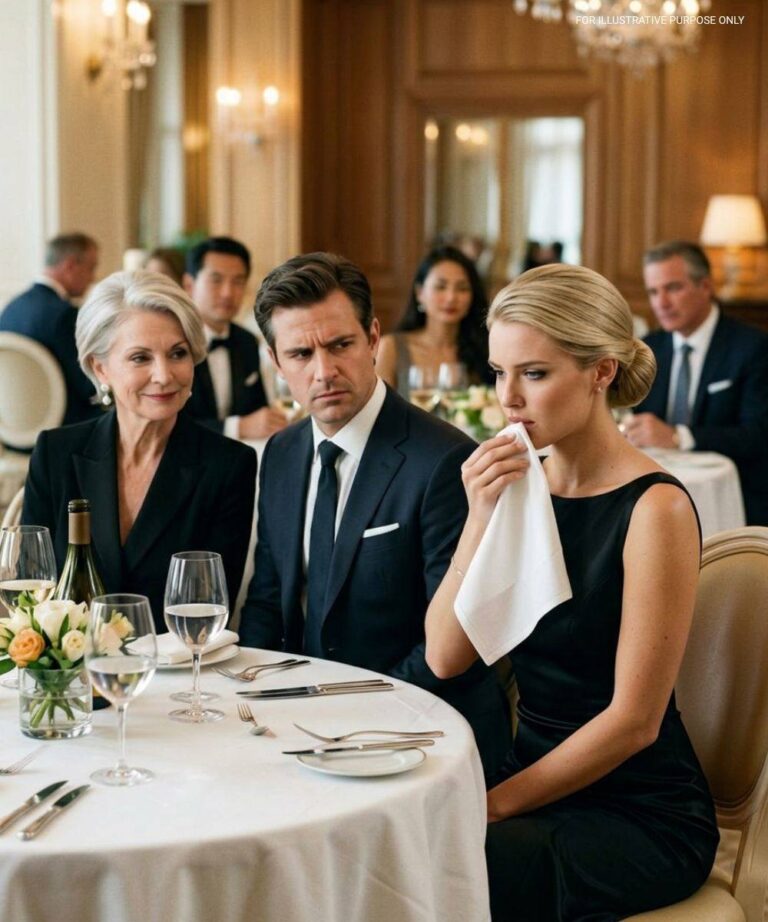
When Nadia’s father passes, his last gift is meant to honor her sacrifices. But when her sister, Emily, steals what isn’t hers to fund a wedding drenched in excess, Nadia refuses to stay silent. On the night Emily hopes to be celebrated, Nadia arrives with a “gift” that no one would ever forget…
When my father, Richard, passed away last year, the world tilted on its axis. I was 28, but the grief hollowed me out until I was like a child again. Losing him felt as though the ground had been ripped out from beneath me, and suddenly the air itself seemed thinner and harder to draw into my lungs.
He had always been my anchor. He wasn’t simply a father in the traditional sense. No, Richard was my confidant, my teacher, my biggest supporter, and the gentlest soul I had ever known.
He was the kind of man who remembered every birthday and anniversary, not with expensive gifts but with handwritten notes tucked under my coffee mug, or phone calls that began with, “I just wanted to hear your voice.”
Even during our hardest years, my father made space for joy. Whenever money was tight, he didn’t complain. Instead, he found small ways to make ordinary days feel special. Sometimes that meant a late-night drive with the windows down and the radio turned up, just to chase away the weight of silence.
Other times, it was a simple joke slipped into a conversation when he knew I was overwhelmed, his eyes twinkling with mischief as he waited for me to laugh.
When I was in college, working shifts at the local gas station store, he would stop by my tiny apartment with takeout containers balanced in one hand and a tired but genuine smile on his face.
“You can’t think on an empty stomach, kiddo,” he’d say, setting the food down before pulling me into a hug that always lasted a beat longer than I expected.
It wasn’t just the food — it was my dad’s way of reminding me that no matter how thinly stretched I felt , I was never truly alone.
That was who my dad was.
He didn’t need grand gestures to prove his love. His life was stitched together by kindness, patience, and presence. And because of that, losing him wasn’t just losing a parent; it was losing my safe place in a world that was often unbearably heavy.
When he got sick, that closeness deepened in ways I could never have imagined. His illness came in stages, each one stealing a little more of him. At first, it was just fatigue — the kind of tired that seemed like it could be solved with an early night.
Then came the endless appointments, the sterile smell of waiting rooms, and finally the long hospital stays that blurred the days together.
My younger sister, Emily, visited maybe twice. Each time, she stood awkwardly at the edge of the bed, more concerned with her phone buzzing in her hand than with the man lying in it.
She always had excuses.
“Oh, Nadia,” she’d say. “I’m busy with work, sis. You know how it is.”
“Hospitals make me nervous. I’d rather wait for Dad to come home.”
“I just can’t handle this stuff,” she muttered once.
The truth was she didn’t want the responsibility.
I, on the other hand, lived inside it.
I juggled my final semesters of college, took on part-time jobs just to keep the bills paid, and somehow managed the endless demands of caregiving.
My mornings bled into nights as I shuffled between writing papers, rushing to shifts, scheduling appointments, cooking meals, and sitting by my dad’s side when the pain kept him awake. And through it all, my mother was with Emily, because apparently Emily needed her more than my dying father.
It was exhausting beyond words, but I never regretted a moment. Because in those quiet spaces, when I combed his thinning hair or walked slowly with him down the hallway, he would squeeze my hand.
“You make me strong, Nadia. And you’re stronger than you think, baby girl,” he’d say.
Sometimes he would tell me stories from his youth — silly things, like the time he and his brother snuck into the county fair, or heavier memories of when he first became a father and didn’t know if he could live up to it.
I realized then that caregiving wasn’t just physical. It wasn’t about tending to his body only. It was about holding his memories, carrying his life with him, and reminding him he wasn’t alone.
One night, when his breathing was rough and I sat on the floor by his bed, he whispered to me.
“You’re my light, Nadia.”
The doctors had warned us. They told us that Dad’s time was short, but nothing in the world can prepare you for that final silence.
After the funeral, we gathered for the reading of the will. My mother, Misha, sat quietly with her hands folded in her lap, her face etched with grief. I knew Dad had written a will — he had even hinted to me that something “special” was set aside — but hearing it spoken aloud was overwhelming.
The lawyer’s voice carried gently through the room as he read the words that my father had written.
I was to receive the bulk of his savings. It wasn’t millions, but it was life-changing: $85,000. It was more than enough to clear my student loans, wipe out credit card debt, and maybe, finally, begin saving for a home of my own.
And even better? Tucked into the envelope was a letter in his familiar handwriting. I opened it with shaking fingers.
“My dearest Nadia,” it read. “You gave up so much to care for me. Your time, your youth, your opportunities — you made sure I was never alone. This money is my way of making sure you can build the future you deserve. Don’t let anyone tell you otherwise. This is yours, my girl.”
Tears streamed down my cheeks as I read it. It wasn’t only about the money — it was the validation, the acknowledgment, and the love woven into every word.
Emily didn’t leave empty-handed either. Dad left her a small jewelry box filled with heirlooms: a gold bracelet that had belonged to our grandmother, a pearl brooch he had bought for our mother, and a pair of vintage earrings he had saved for Emily’s wedding.
They were all beautiful, sentimental pieces, but honestly, they didn’t have much financial importance tied to them.
It felt fair. He wanted each of us to have something meaningful. He also knew who had been there at his side when he needed someone the most. For a while, I believed his wishes were clear, settled, and untouchable.
But that peace didn’t last.
Emily had already been engaged before Dad passed. At first, her plans sounded perfectly reasonable: a big family wedding, maybe a hundred guests — something celebratory but within reach. For a while, I thought she was simply trying to bring some light into a dark season, a way to cope with the loss that was weighing on us all.
But after the will was read, something in my sister shifted. The wedding was no longer a celebration of love; it became a performance.
The guest list swelled to 150 people. She booked a luxury resort ballroom with glittering chandeliers and sprawling terraces. She chose a designer gown that cost more than my annual rent.
And she ordered fountains of champagne and chocolate, commissioned a live orchestra, and even arranged for fireworks to crown the evening.
Whenever Emily spoke about her wedding, she sounded less like a blushing bride and more like a queen preparing for her coronation.
The problem was obvious. Neither Emily nor her fiancé, Connor, had the money to fund such a spectacle. His job was stable, sure, but it was also modest, and her salary barely kept her afloat as it was.
They were a naïve couple building champagne dreams on a soda budget, and as the plans grew more elaborate, I could see where her gaze was landing…
On me — on the inheritance my father had left me.
At first, the pressure came in hints. She would call me in the evenings, her tone sugary sweet and carefully measured.
“Hey, Nadia,” she cooed once. “You know the catering quote is outrageous, right? Dad would’ve wanted Connor and me to have the wedding we’ve dreamed of. You could help out a little, right?”
When I told her no — that the money was for my future, for the sacrifices I’d made — her sweetness quickly soured.
“Wow,” she snapped. “I didn’t think you’d be so selfish, Nadia. Such disappointing behavior.”
But the calls didn’t stop there. Some nights, Emily begged. Other nights, she accused me of convincing our father into leaving the money for me. It was like being cornered by two Emilys: one who tried to charm me, and one who tore at me with sharp words when she didn’t get her way.
Then one evening, she showed up at my apartment unannounced. She pushed her way inside without waiting for an invitation, her heels clicking against the floor, arms crossed tightly as if she was bracing for a fight.
“Do you not understand, Nadia?” she demanded, standing in my living room as if it belonged to her. “This is our wedding we’re talking about. It’s the most important day of my life!”
I folded my arms to mirror her, forcing myself to stay calm.
“And this,” I said stubbornly, “was Dad’s last gift to me. His will was crystal clear, Emily. He wanted me to have this. He wrote it in his own hand. Maybe you should have been a better daughter.”
She rolled her eyes dramatically, as though my words were nothing more than excuses.
About the Author