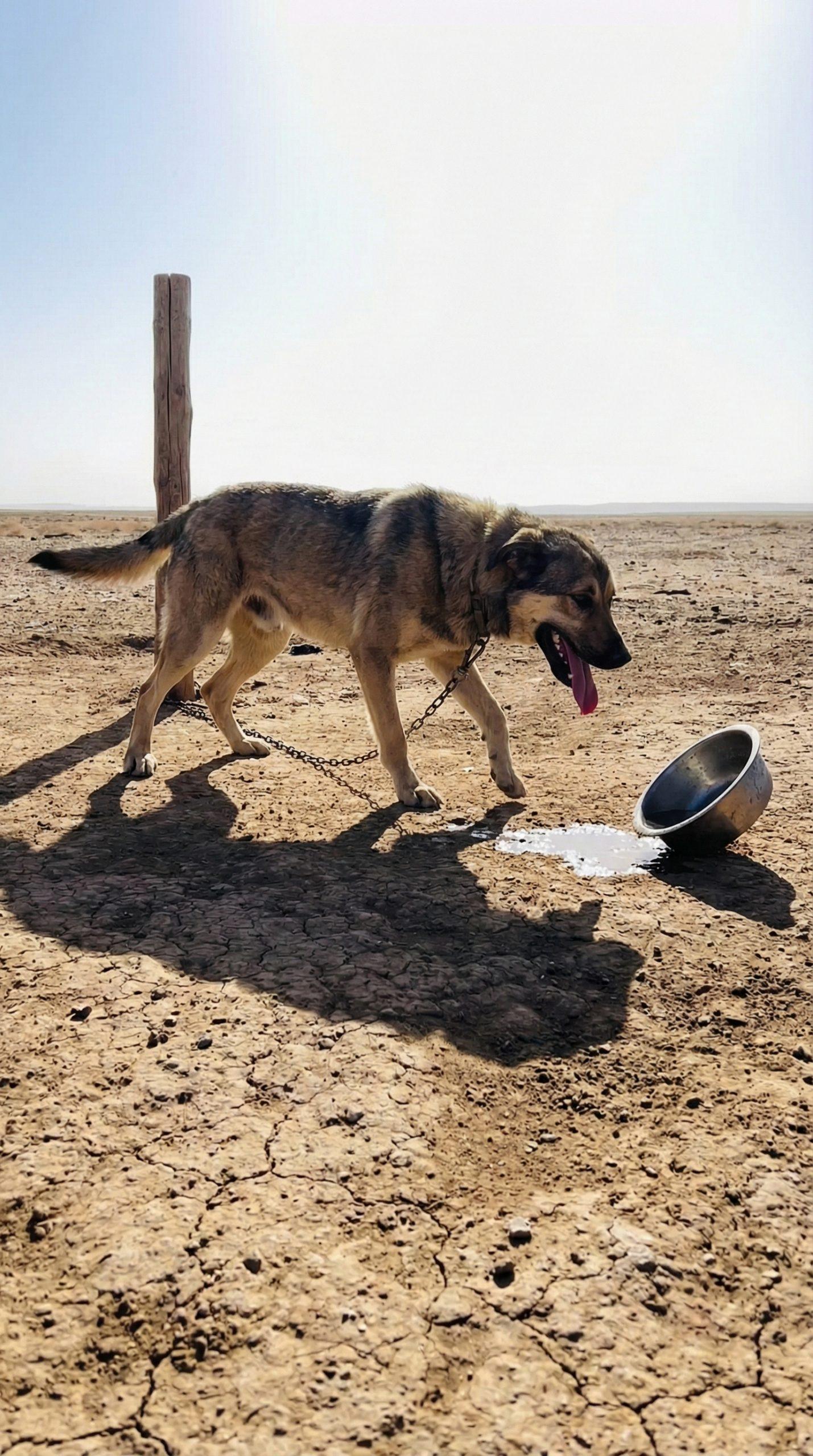
In the scorching expanse of California’s Owens Valley, where the cracked earth stretches like a forgotten promise under an unrelenting sun, a lone German Shepherd mix named Shadow was discovered in a scene that would haunt animal lovers worldwide. Chained to a weathered wooden post with a rusted metal link that barely allowed him to move more than a few feet, Shadow’s tongue lolled out in exhaustion, his fur matted with dust and his eyes pleading for mercy. Beside him lay an overturned metal bowl, its precious contents—a meager puddle of water—seeping into the parched ground. It was July 2024, and temperatures soared above 110 degrees Fahrenheit. The dog, emaciated and dehydrated, had been abandoned in this hellish landscape, a victim of human indifference that would soon reveal itself as something far more sinister.

The story began when a hiker from nearby Bishop, California, named Elena Ramirez, stumbled upon Shadow during a routine trail excursion. Elena, a 35-year-old environmental activist, was photographing the impacts of drought in the region when she heard faint whimpers echoing across the dry lake bed. Following the sound, she found the dog, his chain tangled around the post, forcing him into a perpetual circle of futility. “His ribs were showing, and that bowl… it was like he’d knocked it over in a last desperate attempt to drink,” Elena later recounted in an interview with local news. Overwhelmed by sympathy, she poured water from her canteen into his mouth, untangled the chain, and rushed him to a veterinary clinic in Lone Pine. Little did she know, this act of kindness would ignite a chain of events spanning continents, exposing a tangled network of animal exploitation, illegal trade, and unexpected alliances.
Veterinarians at the clinic scanned Shadow for a microchip, a standard procedure that yielded the first surprising twist: the chip traced back not to a local owner, but to a breeding facility in rural Mexico. Registered under a company called “Perros Guardianes S.A.” in Sonora, the chip indicated Shadow had been bred as a guard dog for high-security operations. But when Elena contacted Mexican authorities, they revealed the facility had been shut down months earlier amid allegations of animal cruelty. Shadow, it turned out, wasn’t just any stray—he was one of dozens of dogs exported illegally across borders. Sympathy for the pup swelled online as Elena posted photos of his recovery on social media, garnering thousands of shares and donations. Yet, curiosity mounted: How did a Mexican-bred dog end up chained in a California desert?
Investigators from the U.S. Fish and Wildlife Service (USFWS) got involved, suspecting wildlife trafficking ties. Digging deeper, they uncovered shipping manifests showing Shadow had been transported via a cargo ship from Veracruz, Mexico, to Long Beach, California, disguised as a “pet relocation.” But the trail didn’t stop there. A forensic analysis of the chain and collar revealed traces of exotic soil not native to North America—specifically, red clay from the savannas of Botswana in southern Africa. This baffling discovery twisted the narrative: Shadow had apparently been part of an international circuit. “We thought it was a simple abandonment case,” said USFWS agent Marcus Hale. “But the soil samples suggested he’d been in Africa recently. It didn’t make sense for a guard dog.”
The plot thickened when Interpol joined the investigation, prompted by the African connection. Records showed that Perros Guardianes S.A. was a front for a larger operation run by a shadowy figure named Javier Montoya, a Mexican national with ties to wildlife poaching rings in Africa. Montoya, it emerged, had been using dogs like Shadow to guard illegal ivory and rhino horn stockpiles in Botswana’s Okavango Delta. These animals were trained to be fierce protectors, chained in remote camps to deter intruders while poachers harvested endangered species. Shadow had been shipped from Mexico to South Africa via a Dutch cargo vessel docking in Rotterdam, Netherlands, before being rerouted to Botswana. But why California?
A breakthrough came from an unlikely source: a whistleblower in Kenya. Miriam Okello, a former employee of a Nairobi-based logistics firm, contacted Interpol after seeing Shadow’s story go viral. Okello revealed that Montoya’s network extended to East Africa, where dogs were used not just for guarding but as unwitting couriers. In a shocking twist, veterinarians in California performed an X-ray on Shadow during his recovery and discovered a small, surgically implanted capsule in his stomach. Initially mistaken for a swallowed object, it was removed and found to contain micro-SD cards with encrypted data—GPS coordinates of poaching sites, buyer lists, and financial transactions totaling millions in illicit wildlife trade.
Sympathy for Shadow turned to global outrage as the story broke in major outlets like The New York Times and BBC News. The data implicated not only Montoya but a web of accomplices: a corrupt official in Botswana’s wildlife ministry, a shipping magnate in the Netherlands, and even a high-profile art dealer in France who laundered poached goods through Parisian galleries. The French connection added another layer of intrigue—Shadow’s microchip had a secondary code linking to a veterinary clinic in Lyon, where he had been “prepped” for his role. It turned out Montoya’s operation rotated dogs through Europe to avoid detection, using them to smuggle data across borders where electronic surveillance was tight.
But the twists didn’t end with arrests. As authorities raided Montoya’s hideouts—first in Mexico City, then in Gaborone, Botswana—they discovered a hidden kennel housing over 50 dogs in similar conditions. Among them was Shadow’s littermate, Luna, who had been chained in the African bush for months. In a heart-wrenching reunion facilitated by animal welfare groups, Shadow and Luna were flown to a sanctuary in the United States. Yet, curiosity peaked when DNA tests revealed an even more surprising truth: Shadow wasn’t a pure guard dog breed. His lineage traced back to wolves hybridized in a secret program in Russia, smuggled out during the 1990s collapse of Soviet-era research facilities. Montoya had acquired these “super dogs” through black market channels in Siberia, breeding them in Mexico for enhanced strength and loyalty.This Russian angle exploded the story into geopolitical territory. Investigators found links to a defunct lab near Novosibirsk, where scientists had experimented with wolf-dog hybrids for military purposes. Some dogs were sold to international buyers, including Montoya, who valued their ferocity for protecting his poaching empire. A former Russian biologist, now living in exile in Canada, confirmed the hybrids’ origins, adding that many had been exported to avoid scrutiny during Putin’s early regime. Shadow, it seemed, was a living relic of Cold War-era bioengineering, his abandonment in California a desperate move by Montoya’s fleeing operatives after a botched deal in Los Angeles.
The global scope evoked waves of sympathy, with petitions circulating from Australia to Brazil demanding stricter international laws on animal transport and wildlife trade. In Australia, where similar drought-stricken landscapes mirror Owens Valley, activists drew parallels to their own abandoned working dogs on outback farms. Brazilian officials, inspired by the case, cracked down on Amazonian poaching rings using imported guard dogs from abroad. Even in India, where street dogs face daily hardships, Shadow’s tale sparked a national campaign against chaining animals in extreme heat.
As Shadow recovered at a sanctuary in Montana, his story took one final, uplifting twist. Elena Ramirez, the hiker who found him, adopted him permanently. But in a revelation that left everyone stunned, Shadow’s implanted data not only led to Montoya’s capture in a dramatic raid in Spain—he’d fled to Barcelona—but also uncovered a hidden fortune. The transactions detailed offshore accounts in the Cayman Islands, funneled from European buyers. Seized assets funded a new international fund for animal rescue, named “Shadow’s Chain,” which has since saved hundreds of dogs from similar fates across continents.
Today, Shadow roams free on Elena’s ranch, his chain a distant memory replaced by boundless fields. His journey—from a Mexican breeder to African guard, European courier, and American hero—serves as a stark reminder of the interconnected cruelties humans inflict on the voiceless. Yet, it also highlights the power of one compassionate act to unravel deceit and inspire change. In a world where borders blur and secrets hide in the shadows, Shadow’s panting plea in the desert proved that even the smallest victim can topple empires. His story, laced with betrayal, resilience, and redemption, continues to captivate, urging us to look closer at the chains we ignore.
About the Author