In the sweltering heat of a forgotten rural corner in rural Odisha, India, where the monsoon rains had long evaporated and left behind cracked earth and whispering bamboo groves, a rescuer named Rajesh Patel stumbled upon a scene that would haunt and inspire him for years. It was late afternoon on July 15, 2024, and Patel, a 42-year-old volunteer with the local animal welfare group PawSaviors India, had been driving his battered Suzuki jeep along a dusty path near the abandoned village of Kenduguda. The village, once home to 200 families, had been deserted two years earlier after a toxic chemical spill from a nearby factory contaminated the groundwater, forcing residents to flee overnight. What Patel found there defied belief: a skeletal mother dog, her ribs protruding like the bars of a cage, hunched over in the shade of a crumbling mud hut, desperately nursing six tiny
puppies. Her fur, once a vibrant reddish-brown, was matted with dirt and blood from open sores, and her eyes—deep, pleading brown pools—locked onto Patel’s with an intensity that spoke of unimaginable endurance. She could barely lift her head, yet her body trembled with the effort to provide milk for her litter, each pup mewling faintly as they latched on with what little strength they had left. This was Hope, as Patel would later name her, a symbol of maternal devotion pushed to the brink in one of India’s most overlooked regions.
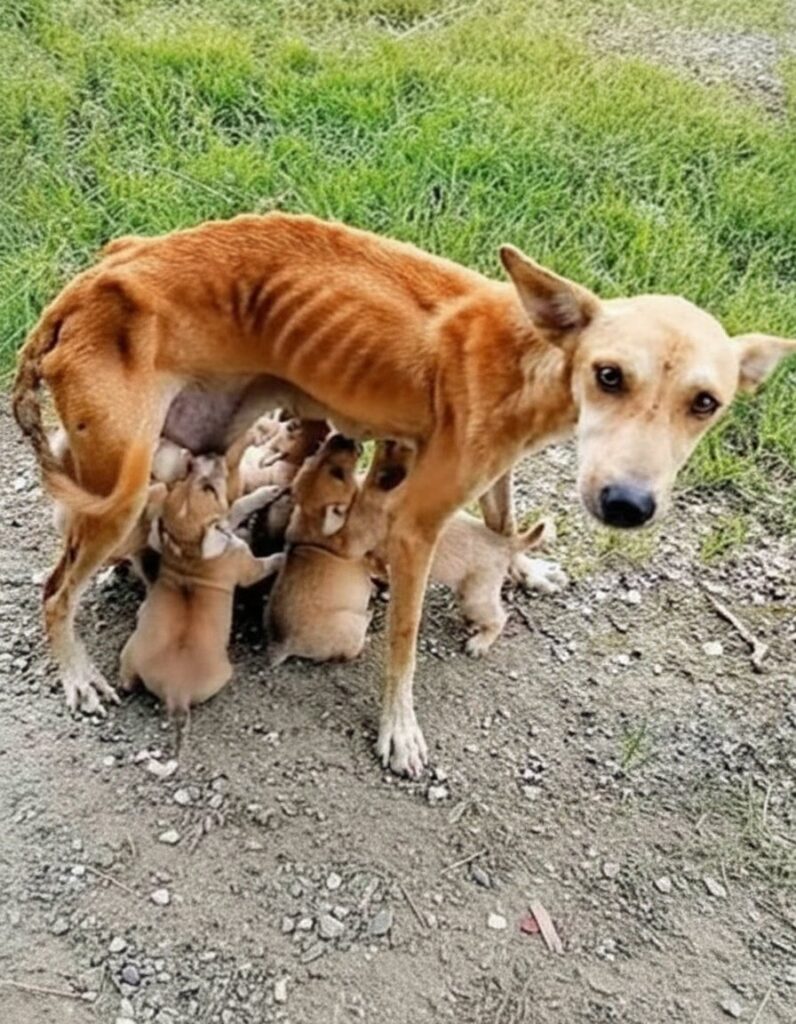
Closer inspection revealed startling details that painted a picture of Hope’s solitary struggle. Her teats were cracked and bleeding from constant nursing, yet milk still trickled out, a testament to her body’s refusal to surrender. One
puppy, the runt of the litter with a distinctive white patch on its forehead, had a leg bent at an unnatural angle—likely broken during birth or from falling into a pothole while Hope foraged. Another pup bore faint scars from what appeared to be bird pecks, suggesting Hope had fought off scavenging crows to protect her young. Scattered around the den were bizarre remnants of human life: a child’s faded plastic toy truck, half-buried in the dirt, and an empty tin of condensed milk with bite marks along the rim—evidence that Hope had raided the village’s leftover provisions. Patel later learned from elderly locals in a nearby town that villagers had occasionally tossed scraps over the fence before leaving, but the chemical spill had poisoned most wildlife, leaving strays like Hope to scavenge contaminated rodents and withered vegetation.
Kneeling beside her, Patel spoke softly in Odia, the local dialect, while slowly offering a piece of soaked biscuit from his supply bag. Hope flinched at first, her ears pinning back in fear, but hunger won out. She devoured it with feeble snaps of her jaws, her tail giving the slightest twitch—a flicker of trust. This moment was captured on Patel’s phone camera, a shaky 30-second video that would soon go viral. But rescue wasn’t straightforward. As he prepared a makeshift sling from his jacket to lift her, Hope growled protectively, refusing to let go of her pups. In an unexpected twist, one puppy detached and waddled toward Patel, sniffing his boot curiously. This broke the ice; Hope watched warily as he gently scooped up the bold explorer, then the others, placing them in a padded crate. Only then did she allow herself to be moved, collapsing into the sling with a sigh that sounded almost like relief.
The 45-minute drive to the PawSaviors clinic in Bhubaneswar was tense. Patel’s jeep broke down twice—first from a flat tire on a sharp rock, then from overheating in the 38°C (100°F) heat—delaying their arrival until dusk. At the clinic, veterinarian Dr. Priya Sharma assessed the family with a mix of horror and admiration. Hope weighed just 8 kilograms (17.6 pounds), half what a healthy adult Indian pariah dog should. Blood tests revealed severe anemia, dehydration, and elevated toxin levels from the polluted water she’d been drinking. Shockingly, her milk tested positive for malnutrition-induced ketones, meaning the pups had been surviving on what little nutrient-poor sustenance she could produce. “She’s a miracle,” Dr. Sharma told local reporters that night. “Most dogs in her condition would have abandoned or cannibalized their litter weeks ago. This level of devotion is rare even in domestic pets.”
Treatment began immediately. Hope received IV fluids laced with vitamins, while the
puppies were bottle-fed a specialized puppy formula every two hours. The injured runt, dubbed Lucky by the staff, underwent surgery for his leg the next day, fitted with a tiny splint made from popsicle sticks. Over the following days, unexpected challenges arose: one pup developed diarrhea from the sudden richness of formula, requiring round-the-clock probiotics, and Hope suffered a panic attack during her first bath, slipping from a volunteer’s grasp and hiding under a table. Yet progress was swift. By day five, Hope could stand unaided, her eyes regaining their sparkle as she playfully nudged her increasingly energetic pups.
The story of Hope spread like wildfire across India and beyond, amplified by social media. The viral video garnered over 2.5 million views on X (formerly Twitter) within 48 hours, with users from the UK to the US sharing it alongside messages of support. Donations poured in—₹15 lakhs (about $18,000 USD) in the first week—funding not just Hope’s care but a new outreach program for stray animals in contaminated zones. Local authorities, initially dismissive of the village’s plight, launched an investigation into the chemical spill, crediting public outrage sparked by Hope’s story. In a particularly heartwarming turn, a family in Mumbai adopted Lucky after seeing his recovery photos, flying him first-class to his new home—complete with a custom wheelchair during his healing phase.
Today, five months later, Hope and her remaining five puppies thrive at the PawSaviors sanctuary, awaiting permanent homes. Hope, now a robust 18 kilograms with a glossy coat, bounds through the enclosure, teaching her pups to chase butterflies. Patel visits weekly, often bringing treats from his own kitchen. “She taught me that survival isn’t just about strength,” he reflects. “It’s about holding on for those who depend on you.” Hope’s journey from the brink of death to a beacon of resilience has inspired a nationwide conversation about animal welfare in disaster-struck areas. In Kenduguda’s ruins, where ghosts of the past linger, one mother’s unyielding love has ensured a future for her family—and hope for countless others.
About the Author